
Meet RotaTiger, the rota and holiday planning management tool for businesses
RotaTiger plans staff rotas and manages holiday and sickness for UK and US businesses. We designed and built it ourselves, from the database to native iOS and Android apps.
Updated 16 November 2026: the iOS app is now on the App Store (6 November) and the Android app on Google Play (10 November). We've also added our latest security work below.
This post is about how it works underneath. Rota software looks simple from the outside, but the hard parts are employment rules, shift patterns that don't fit a calendar, and personal data that has to stay private. They're the same problems we solve for clients.
Why we built it
RotaTiger started with our own frustration. We used Timetastic to manage holiday, and it worked well enough until some of our staff moved to compressed hours. Holiday was being counted in days, but a day off for someone on four 10-hour days isn't the same as a day off for someone on five 7.5-hour days. Getting the balances right meant working them out by hand alongside the system.
We looked for something that counted holiday in hours from each person's actual working pattern and didn't find what we wanted, so we built it. That problem shaped the whole design.
We've since extended RotaTiger well beyond holiday into advanced rota management, guided by competitor analysis and gap analysis of the other rota and leave products on the market. You can see where it stands on the RotaTiger comparison page.
Simple first: hidden complexity
Software that can handle rotating crews, statutory sick pay and fatigue rules can easily overwhelm a café that just wants to know who's on tomorrow. So we designed RotaTiger's interface around hidden complexity: it's simple to use from the first day, and the extra power is there when you go looking for it.
A new company starts with the essentials: a rota, holiday and sickness. Typing 10-2 into a day adds a shift. The advanced features stay out of the way until you switch them on:
- Staffing needs and Auto-fill, for teams big enough to want the week drafted for them
- Fatigue checks, turned on in Settings when shift patterns make them worth having
- Two-step verification and passkeys, which a company can leave optional or make compulsory for admins or everyone
Each feature you enable unlocks more of RotaTiger, and nobody has to learn what they don't use.
RotaTiger is still growing. We keep adding features and changing what's there, and customer feedback has a direct say in what we build next.
What we built
RotaTiger is four codebases that share one API:
| Part | Technology | Size |
|---|---|---|
| API | .NET 10, MongoDB, SignalR | About 47,000 lines of C#, 421 endpoints |
| Web app for managers | Angular 21, Tailwind CSS | About 31,000 lines of TypeScript |
| Native iOS app, including iPad and iPhone Duo | SwiftUI, Swift 6, WidgetKit | About 15,000 lines of Swift |
| Native Android app | Kotlin, Jetpack Compose, Material 3 | About 14,000 lines of Kotlin |
On top of that API sit two ways for other systems to work with RotaTiger. A customer-facing REST API, with signed webhooks, lets businesses connect RotaTiger to their payroll, HR and reporting tools. An MCP server lets AI assistants such as Claude and ChatGPT read and act on RotaTiger for the person who's signed in. Both are covered in more detail below.
The website at rotatiger.com is a separate Next.js site. The API and web app started from our own .NET and Angular starter project, which already handled sign-in, permissions and keeping each company's data separate.
A leave engine that counts in hours
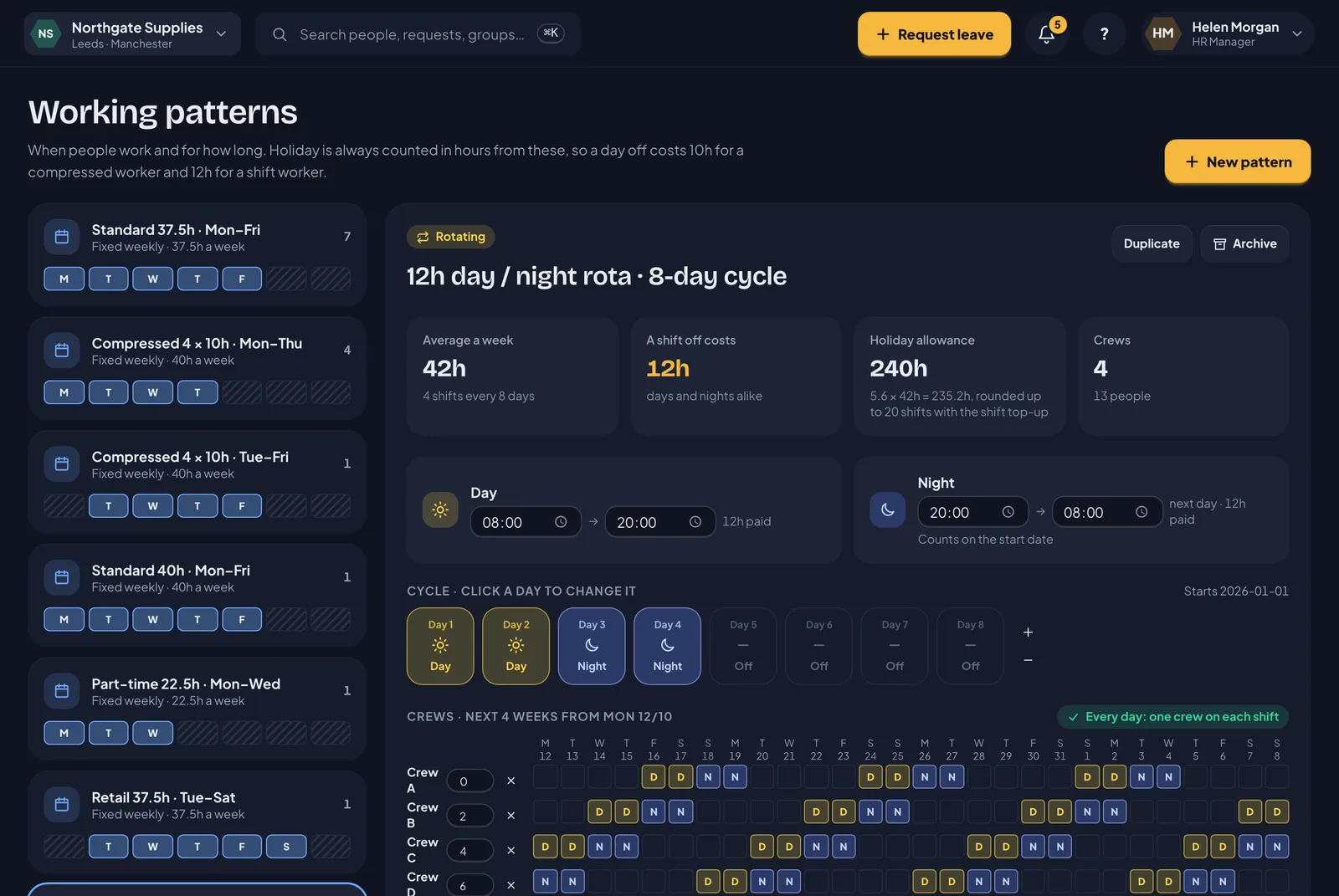
Most leave software counts holiday in days. That breaks as soon as people work different hours: a day off is 7.5 hours for one person, 10 for someone on compressed hours and 12 for a night worker. RotaTiger counts every booking from the shifts that person would actually have worked.
To make that reliable, we built the calculation as a separate engine:
- Every figure is a whole number of minutes. There's no floating-point drift, and a balance shown as "14 days (140h)" is worked out from minutes at display time.
- The calculator is pure. It doesn't touch the database or read the clock, so the same inputs always give the same answer and every rule can be unit tested.
- Working patterns plug in behind one interface. There are engines for a fixed week, a rotating crew cycle of up to 56 days, casual hours and a rota planned week by week. A wrapper applies shift swaps and cover on top of any of them.
- Night shifts belong to the day they start. A 20:00–08:00 shift ends at minute 1,920 of its start day rather than being split across two dates.
- Changes are recalculated. When someone's pattern changes part-way through the year, the API re-costs their future approved and pending leave from that date, leaves past days alone, and tells the person if a balance changes.
Employment rules sit on top of the engine and change with the company's country. UK companies get bank holiday calendars for England and Wales, Scotland and Northern Ireland, statutory sick pay with linked periods and the 28-week cap, holiday records for casual workers at 12.07% of hours worked, and 6-year record retention. US companies get federal holiday observance rules, PTO accrual and state sick-leave templates. Easter is calculated rather than stored, so the calendars never run out.
When a bank holiday falls on someone's day off, the company decides what happens: nothing, the next working day off in lieu (skipping any other bank holidays), or a credit to their balance.
A scheduler that explains itself
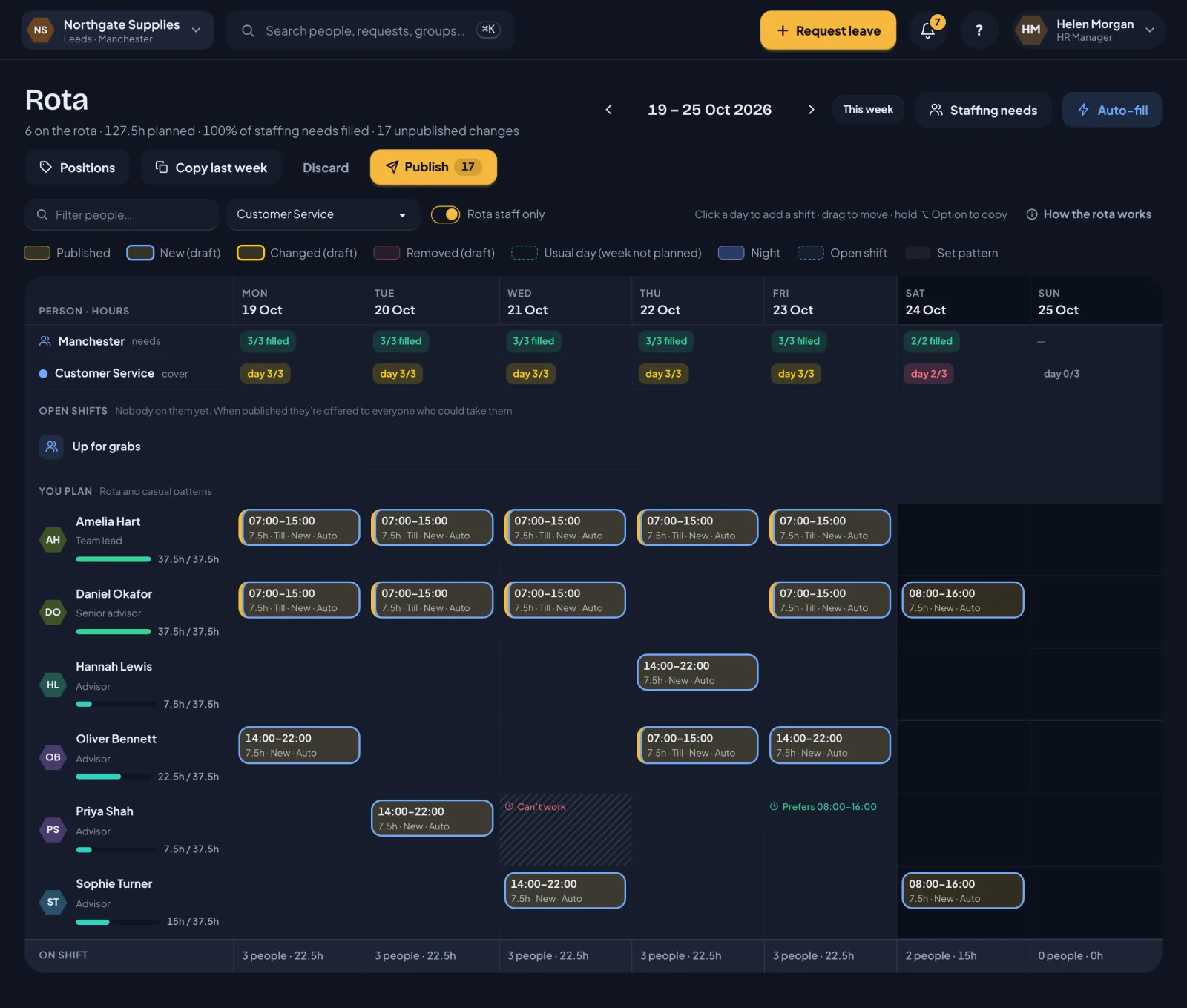
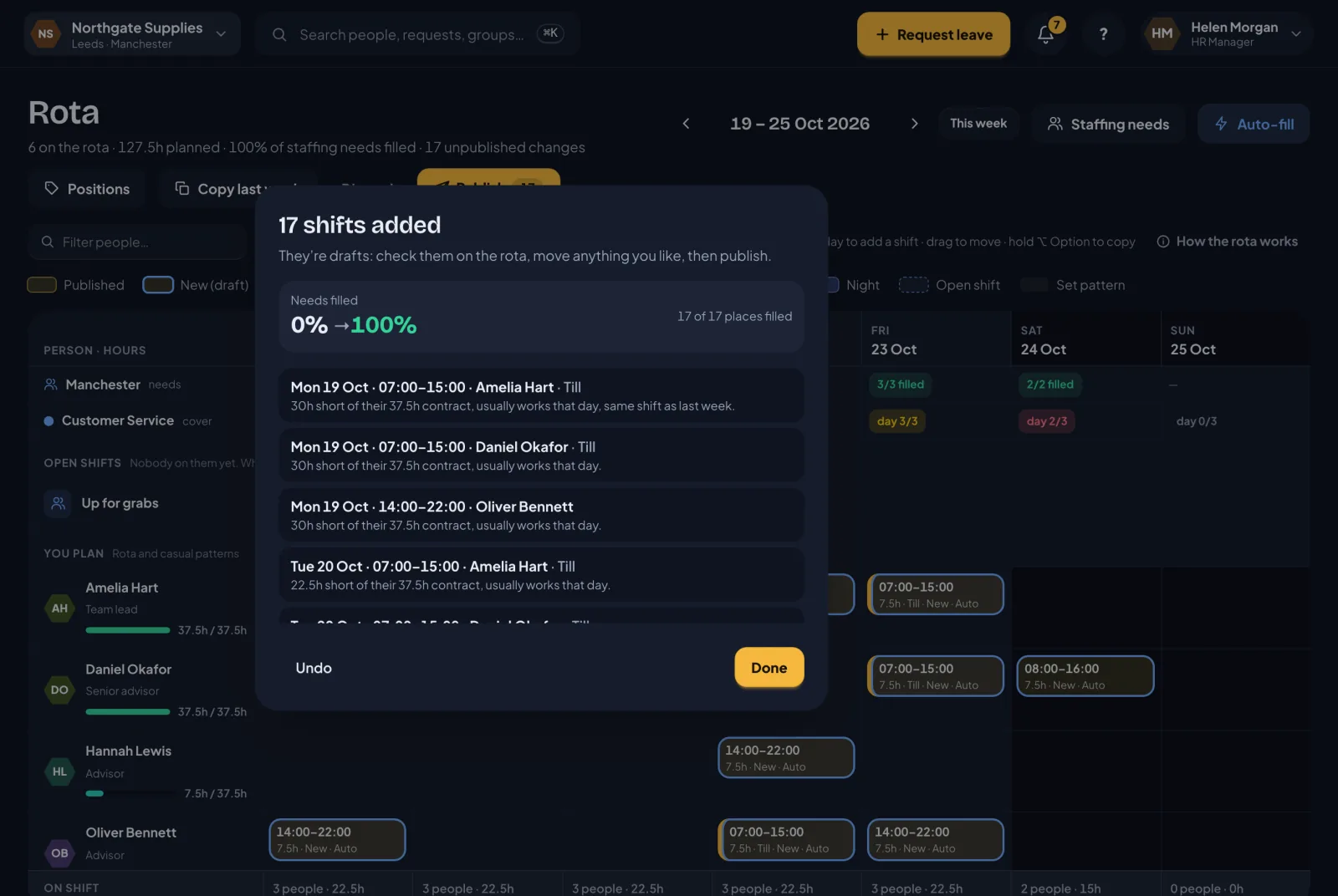
Managers set how many people each location and shift needs, then press Auto-fill. The scheduler is deterministic: the same rota and the same staff always give the same result, which makes it testable and predictable for managers.
It fills the hardest shift first, meaning the one the fewest people can take, then scores everyone eligible. People below their contracted hours, people who prefer that shift and people who usually work that day score higher. Recent weekends, nights and late closes, a second shift on the same day, and any rule warnings all count against them. Every assignment comes with a plain-English reason, and any shift nobody can take becomes an open shift with the reasons listed.
Each shift is checked as it's placed against leave, sickness, availability (including availability that crosses midnight), weekly hours caps and rest between shifts. Hard limits block the shift. Softer ones show as warnings.
Fatigue rules from HSE guidance
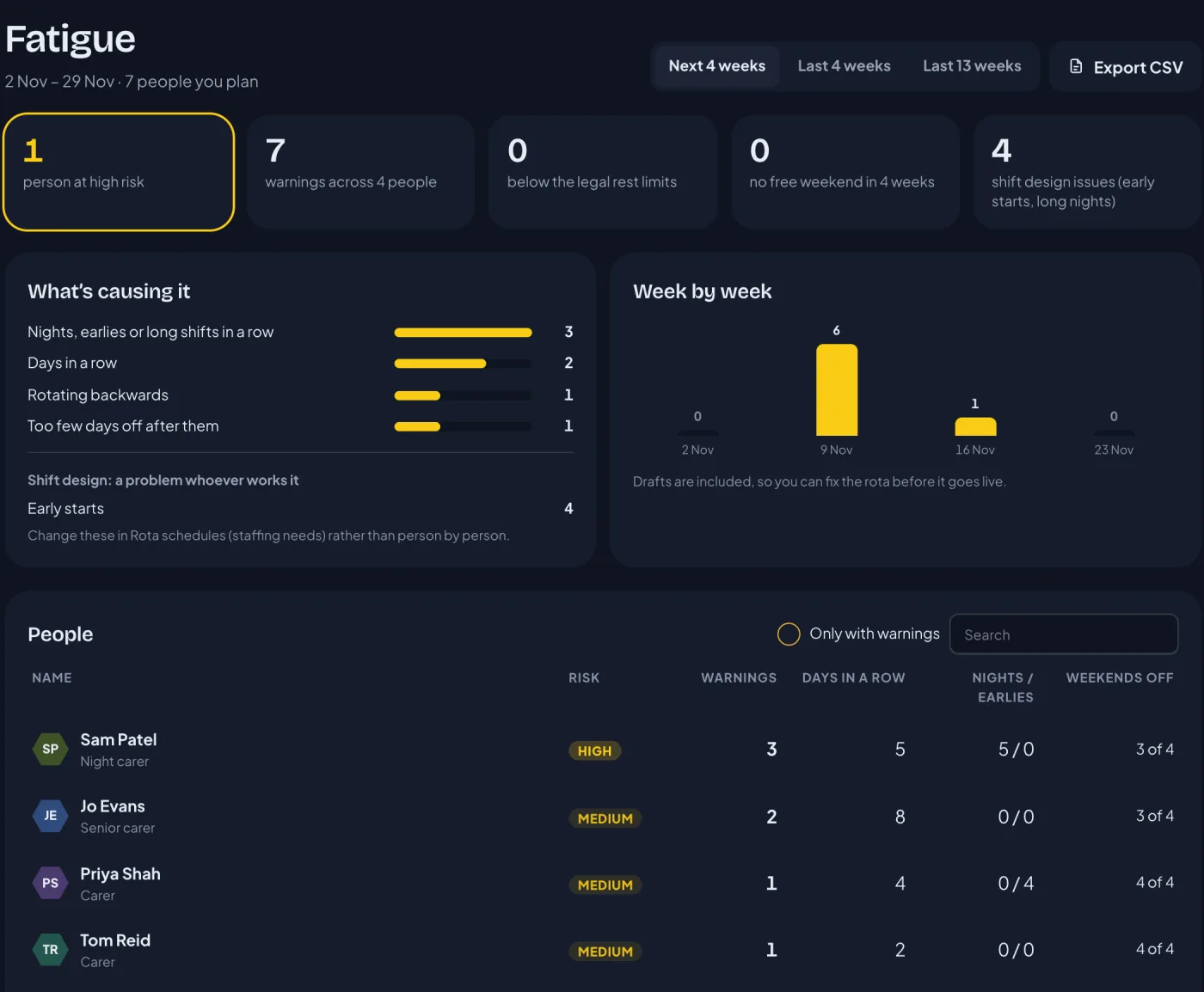
Fatigue checks are optional and use 11 rules. Nine come from the Health and Safety Executive's guidance on shift work, such as runs of nights, backward rotation, early starts and too few free weekends. The other two are legal limits that always apply: weekly rest under the Working Time Regulations and the average limit on night work.
The rules run in two modes. While Auto-fill is choosing people, every shift that's part of a problem counts against them. On the rota, only the shift that tips a run over the limit is flagged, so seven days in a row shows one warning, not seven.
Encrypting the data that matters most
A rota system holds some of the most sensitive information a business has about its staff. Sickness reasons and return-to-work forms are health data, and UK GDPR treats them as special category data. We designed it so that a copy of the database on its own, or a curious administrator browsing it, can't expose them.
- Encrypted before it's stored. Sickness reasons and return-to-work forms are encrypted with AES-256-GCM inside the API, before they reach the database. What MongoDB holds is unreadable on its own.
- A key for every person. Each employee has their own encryption key. Those keys are themselves encrypted with a master key held outside the database, and the master key can be rotated without downtime.
- Values can't be moved. Each encrypted value is bound to its company, person, absence and field. Copying it onto another record makes it fail to decrypt rather than show the wrong person's details.
- Deletion that really deletes. Destroying a person's key makes every encrypted note about them unreadable at once in the live system. This is known as crypto-shredding.
- Need to know. Colleagues see someone as "Away". Only their manager and HR can see the reason.
- Existing data included. A migration encrypted the notes already in the system, so nothing was left behind in plain text.
The same care runs through the rest of the system:
- Tenant isolation. Every request names the company it's for, and middleware checks the caller belongs to it before anything runs. If no company is set, access is refused. Real-time messages are filtered the same way.
- Permissions. Access is checked against 30 named permissions, not a few broad roles.
- Sign-in. Passwords are hashed with BCrypt. People can also use Google, passkeys or an authenticator app, and a company can make two-step verification compulsory. Changing your second factor needs a strong sign-in first, and sign-in attempts are rate limited.
- Approve from email. Managers can approve leave straight from an email. Each link is single use, tied to that request and that manager, stored only as a hash, and stops working if the request changes.
- Data downloads. When someone downloads their own records, the file can be protected with a password.
Security is a continuous job
Software that's secure on launch day doesn't stay that way. New attacks are published all the time, the frameworks and libraries underneath get patched, and anything with a public sign-in page is probed constantly. So we treat security as ongoing work, not a box ticked before release. RotaTiger is tested rigorously and regularly and kept up to date with the latest vulnerability fixes.
In practice that has meant:
- Testing every area that faces the outside world. Before launch the whole system went through a penetration-style test. The AI assistant connection, and the API and webhooks that customers integrate with, each had their own security review. Every issue found was fixed, with an automated test added so it can't quietly come back.
- Hardening each app, not just the server. Fixes have gone into the web app (a stricter check on where sign-in can redirect to, and Angular's built-in sanitiser instead of a hand-written filter for chat messages) and into both mobile apps (the sign-in token is only ever sent to RotaTiger's own servers, and reinstalling the iOS app doesn't reopen an old session).
- Staying on supported platforms. We moved the API to .NET 10, the current long-term support release, before support for .NET 9 ended on 10 November 2026, so it keeps receiving Microsoft's security patches. Libraries such as the MongoDB driver and authentication packages are updated, and old ones removed.
- A checklist for every release. Each deployment follows a written security checklist, and the servers send strict browser security headers such as a content security policy and HSTS.
An API for customers' own systems
Businesses rarely use one system on its own, so RotaTiger has a versioned public API at /api/v1. Customers can read people, teams, locations, leave types, balances, time off and shifts, and create, approve, decline or cancel leave requests from their own software.
- Scoped API keys. An administrator creates each key with only the scopes it needs, such as reading people or writing leave. Keys can expire after 30, 90 or 365 days, can be restricted to set IP addresses, and are stored only as a hash. Sickness data needs its own scope, and only someone allowed to see sickness can grant it.
- Safe to retry. Write requests accept an Idempotency-Key, so a request retried after a network failure is never applied twice. Each key has its own rate limit.
- Signed webhooks. RotaTiger can notify a customer's system when a request is created, approved, declined or cancelled, when someone is off sick or back, when people join or leave, and when a rota is published. Events come from the audit log that every change already passes through, so nothing can change without its event being sent.
- Reliable delivery. Each webhook is signed with a timestamp and secret so the receiver can check it came from RotaTiger, and failed deliveries are retried with increasing delays. Webhook addresses are checked so they can't be pointed at internal networks.
Slack and Microsoft Teams notifications use the same webhook system.
AI integration through MCP, with a human in the loop
RotaTiger has an MCP (Model Context Protocol) server, so people can use it from Claude, ChatGPT and other AI apps. Staff can ask who's off or check their balance. Managers can ask about their team and approve requests.
The server has 22 tools that act as the signed-in person, through the same services and permission checks as the apps. Connections use OAuth 2.1 with PKCE and rotating refresh tokens, and a reused token ends the connection.
Two design choices keep it safe:
- Nothing changes without a yes. Any action that would book, approve or change something returns a preview and a one-time code. The person confirms, and only then does it happen.
- Free text never reaches the model. Notes people type on requests and shifts are left out, so nobody can hide instructions in a note.
Native iOS and Android apps
Staff use the apps to see their shifts, pick up open shifts, book time off and say they're not well. Managers approve requests from the same app. We built both natively rather than wrapping the website:
- iOS: SwiftUI with Swift 6 strict concurrency, lock-screen and home-screen widgets, passkeys and Face ID, and layouts that adapt to iPad and the new folding iPhone Duo, whether it's folded or open.
- Android: Kotlin and Jetpack Compose with Material 3, home-screen widgets, passkeys through Credential Manager, a session encrypted with the Android Keystore, and a biometric lock after 5 minutes away.
Both apps get push notifications with action buttons through Firebase Cloud Messaging, and notifications reach the web app live over SignalR.
Tested and run like a production system
- Around 1,000 automated tests. The API has 540 integration tests that run against a real MongoDB using Testcontainers, so they test the actual queries rather than mocks. The web app has about 260 tests, and the iOS and Android apps about 120 each, including UI tests that tour the screens.
- Time zones. Each company's "today" comes from its own time zone, and the calendar feed handles the hour that disappears when the clocks go forward.
- Jobs that run once. Scheduled emails and notifications are recorded with a once-only key, so a restart or a second server can't send them twice.
- Infrastructure. The API runs in Docker as a non-root user behind nginx and Cloudflare, with a strict content security policy and HSTS. The database is MongoDB Atlas.
- Moving from another product. An importer reads a Timetastic export and rebuilds day-based bookings in RotaTiger's hours model so balances match. Running it twice changes nothing.
What this means for your project
RotaTiger is our own product, but the work behind it is what we do for clients: turning complicated rules into software that gets the numbers right, building native mobile apps alongside a web app on a shared API, encrypting sensitive personal data and keeping systems secure long after launch, and connecting systems to AI in a way people can trust.
You can see RotaTiger in action at rotatiger.com, or download it from the App Store or Google Play.
Have a system like this in mind?
We design and build web apps, native mobile apps and the APIs behind them. Tell us what you need.